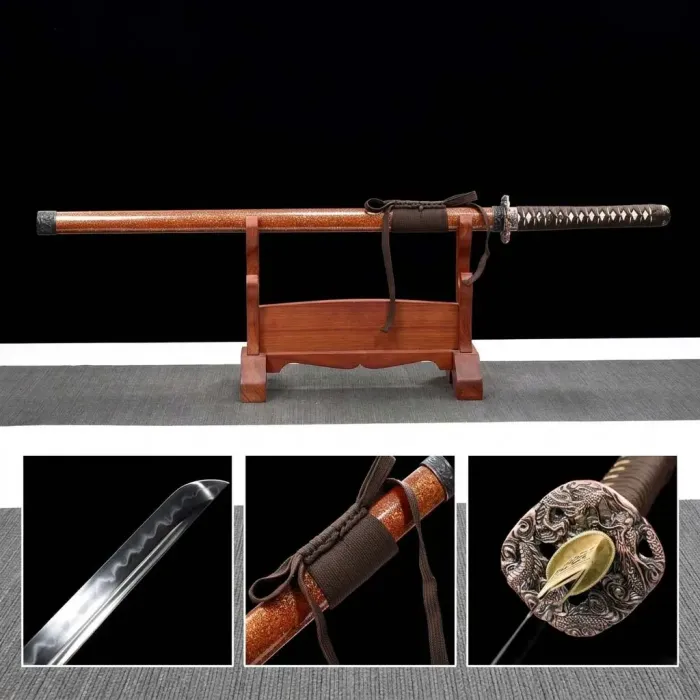
A time-honored historical sword is a exquisite example of fabrication, but how about you aim to to exhibit your separate character? Adjusting your blade is a insightful journey, allowing you to create a truly matchless piece. From the grip wrapping and collar to the barrier design and blade pattern, each constituent offers a chance for tailored look. This investigation delves into the sphere of katana adjustments, providing facts for both beginners and proficient enthusiasts hoping to make their footprint on the long-standing art of the samurai.
Newcomer's Original Creation
For aspirants wanting to embark on the satisfying journey of martial arts involving swords , 1060 steel katanas deliver an superior entry point. This defined grade of essential steel reaches a perfect balance between price and quality . While never as hard as premium steels, 1060 provides a reasonable level of cutting preparation , making it tailored to trainees to cultivate the foundations of blade preservation and understand the allure of handcrafted Japanese weaponry. It’s a fantastic choice for obtaining experience without the capital burden of more sophisticated steels.
Grade T10 Sabers : Achieving Performance and Expense
Assisting specialists seeking an authentic saber experience without breaking the monetary limit , T10 steel katanas represent a appealing option. These tools offer a noticeable improvement in lastingness compared to cheaper alternatives, exhibiting respectable edge retention and sufficient flexibility for simple hacking techniques. While not rivaling the superior characteristics of elite steels like T100 or folded substance , T10 provides a remarkable blend of performance and economy , making them a appreciated choice for beginners and those on a restrained financial .
Exceeding the Keel : Refining Your Armament's Ornaments and Haft
Though the finished metallic edge is undeniably the essential point of a katana, truly amplifying its elegance lies in the exact customization of its elements and hold. This process allows owners to manifest their inimitable design . Contemplate the wide possibilities: menuki - decorative appliqués that supply visual detail ; the hamon wrappings – often exquisitely carved ; the tsuka core itself, wrapped in conventional ito yarn; and the fusa pommel , which can be formed from various materials like ingots or antler .
- Prefer concepts that resonate with you.
- Assess with varying composites .
- Focus on robustness for a enduring result .
The Attraction of the Katana: Legacy, Artistry, and Steelwork
The samurai blade exhibits a matchless allure, steeped in ages of the nation's history and culture . More than merely a apparatus of battle , it's a embodiment of the knight ethos – a fusion of ability and rule. Its development spanned numerous generations, with early swords evolving into the elegant curvature and lethal edge we acknowledge today. The creation involved is truly extraordinary , requiring years of apprenticeship to complete. The process involves a sophisticated folding of wrought steel , creating layers that reinforce the weapon’s flexibility and cleaving ability. Various schools of processing appeared , each with their unique secrets and methods for achieving the flawless harmony and edge - a truly heavy pursuit.
- Original Katana forms
- The responsibility of the oriental sword in fighter culture
- Traditional smithing procedures
Choosing the Fitting Steel for Your Sword Project Project: 1060 vs. T10
Choosing the appropriate steel is critically important for any armament project, and the decision between 1060 and T10 can be difficult. 1060 is a favored American composition, offering a decent balance of resilience and endurance, allowing it moderately easy to manage. However, T10, a originating from Japan steel, frequently boasts amplified wear resistance and can arguably achieve a enhanced end hardness, although it can be somewhat challenging to control sword custom and requires precise heat conditioning. Consider your competency and expected goals: for a beginner, 1060 may be a simpler basis, while the veteran smith might value the improved details of T10.
- Accessibility of Working
- Wear
- Final Toughness
Accessing Excellence: Progressive Katana Alteration Approaches
Mastering the art of katana alteration extends far beyond basic finishing. Serious practitioners are now exploring advanced techniques to truly discover a blade's hidden potential. This requires intricate work with the hamon, utilizing specialized products for differential heat treating and carefully nominating the contour of the hand guard to optimize balance and functionality. Beyond purely functional modifications, artisans are increasingly focused on generating unparalleled aesthetic grace, through complex decorating and layered surfaces that truly transform a katana into a artistic composition.
From Ordinary Steel to Fine Blade: Fabricating a 1060 Katana
The journey commences with regular 1060 substance, a robust material far distant the deluxe katana it will become . Master bladesmiths carry out a multifaceted process of layering and crafting the initial steel, repeatedly glowing it and hammering it to eliminate impurities and form a steady grain structure. This tiring process, often continuing for stretches , builds the crucial sturdiness and malleability characteristic of a legitimate Japanese cutlery . Supplementary heat adjustments , including meticulous hardening and conditioning , are necessary to achieve the sought-after steadiness of sharpness, life and elegance .- Folding: Diminishes impurities and constructs grain structure.
- Crafting: Forms the steel into the initial blade form.
- Cooling: Controls the final hardness and flexibility.
The Perpetual Attraction of the Katana: Extensive Study of Steel and Alteration
A long-standing katana persists a powerful symbol signifying Japanese artistry , its enticement far exceeding mere weaponry . Forged from rare steel and frequently featuring intricate ornaments , the method of creation itself is a esteemed art. Beyond the fundamental craftsmanship, the ability to tailor a katana - from the patterning to the grip wrapping and fastening - enables for a perfectly individual exhibition for both admirers and operators alike. This combination of time-honored steelwork and boundless personalization effectuates the katana's continued popularity across the world .